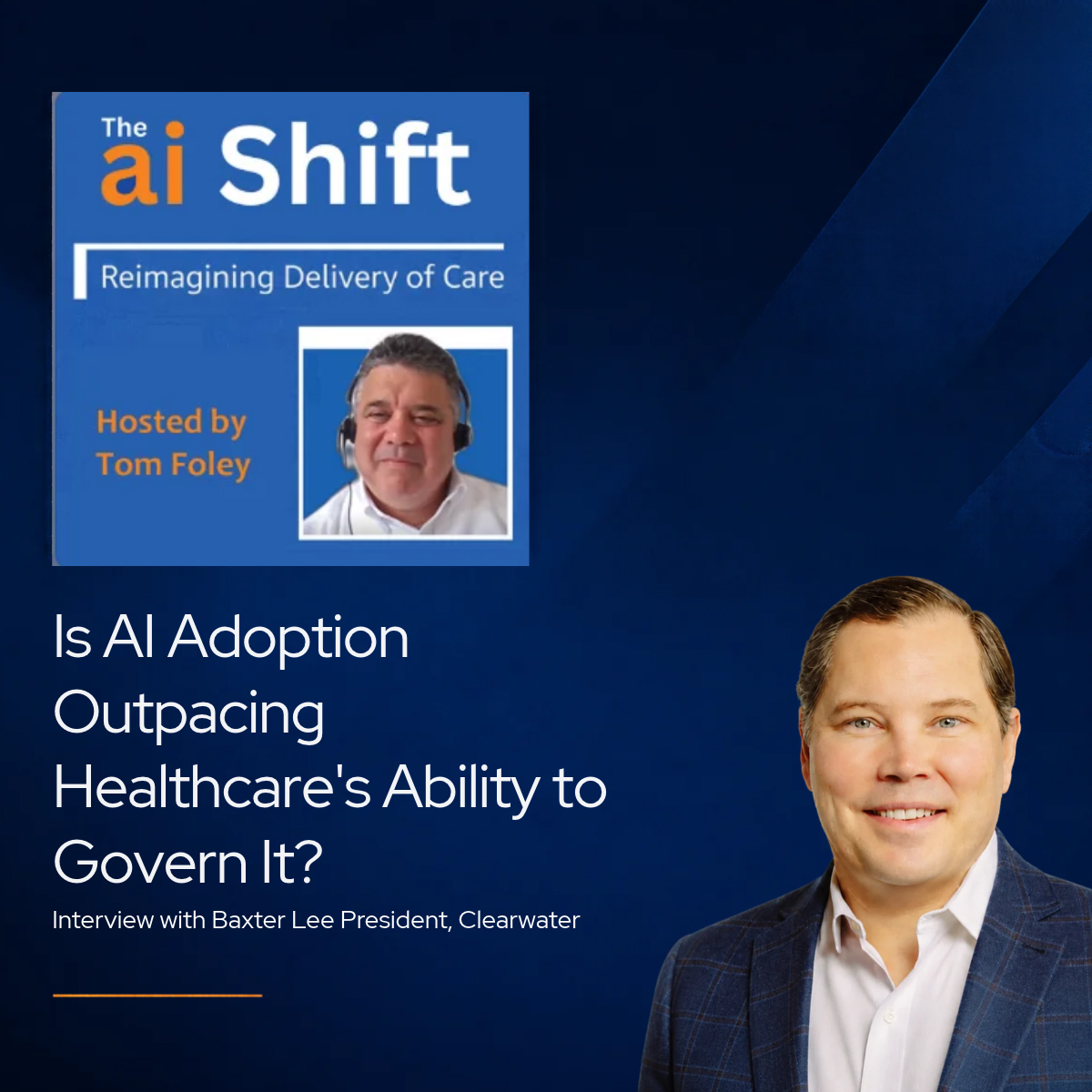
The AI Shift · Baxter Lee, President, Clearwater
Most cannot. Clearwater’s 2026 Healthcare AI Benchmark Study found that 91% of healthcare organizations cannot verify what artificial intelligence (AI) is running in their environment. Governance policies are in place. Enforcement and evidence are not. In this episode of The AI Shift, host Tom Foley talks with Clearwater President Baxter Lee about what that gap means for Chief Information Security Officers (CISOs), boards, and patient care.
In this conversation:
- Why governance documentation is not the same as oversight
- How AI agents shift security from guarding the perimeter to controlling access inside it
- A three-tier model for matching controls to the clinical risk of each AI use case
- Why third-party vendors are the hardest part of AI risk to verify
- What the CISO role now includes
What did the 2026 Healthcare AI Benchmark Study find?
The study set a baseline for how healthcare organizations are managing AI adoption.
- 91% cannot verify what AI is actually running in their environment.
- Only 4 in 10 can demonstrate that they control how data is sent to AI tools.
- 86% cannot demonstrate that their vendors’ AI controls are fully verified. Only 14.3% do.
- Two-thirds name security and privacy concerns as their biggest barrier to adopting AI.
Read the full 2026 Healthcare AI Benchmark Study.
Why is AI governance not the same as AI oversight?
Governance has a lag. Many organizations have built governance structures and inventory capabilities, but those policies are not fully enforced. A policy can make leaders feel they are doing the right thing. Verification is what shows whether the AI is operating as intended.
How does AI change the CISO’s job?
Traditional security reinforced the walls of the castle. AI agents require checking the doors inside it, so that an agent empowered to act on an organization’s behalf cannot reach data it was never meant to touch. That puts identity and access management at the center. CISOs are also being asked to monitor model effectiveness and drift, not only security and privacy.
How should healthcare organizations prioritize AI risk?
Lee describes three tiers. Administrative uses carry the least exposure. Revenue cycle uses touch patient data and carry financial risk. Clinical decision support and patient engagement demand the strongest controls, because model behavior can affect care. Controls, governance, and monitoring should scale with the tier. Clearwater’s AI governance services help organizations build and operate that structure, from inventory and policy through ongoing program management.
About the guest: Baxter Lee is President of Clearwater, which provides cybersecurity, privacy, and compliance advisory services to healthcare organizations. He joined Clearwater as Chief Financial Officer in 2018 and became President in September 2025.